The idea of a city as an environment for living came on the agenda of the designers during the 1970s. This was connected for the designer with an interdisciplinary approach, especially with architects and city planners. One prominent example for this is an international seminar in Georgia in the fall 1980.
The seminar “Design for City Environment” was held from the 6th to the 18th October 1980 in Tbilisi. It was organised within the seminar series by the Soviet VNIITE in cooperation with the ICSID, the IAA (International Association of Art), the ISOCARP (International Society of City and Regional Planners), the ICOGRADA (International Council of Graphic Design Associations), the ICOMOS (International Council of Monuments and Sites), the IFI (International Federation of Interior Designers), the IFLA (International Federation of Landscape Architects), the UIA (International Union of Architects) and the WCC (World Crafts Council).1
The 34 participants came from the USSR and from Western countries.2 The professions were widely mixed, thus designers, architects, and met in the capital of the Georgian Soviet Republic at the regional office of the VNIITE. Tbilisi itself was chosen because of a number of its features: there was a combination of a national tradition as well as modern architecture. The city was with over a million inhabitants hugh and had a situation with special climatic conditions.3
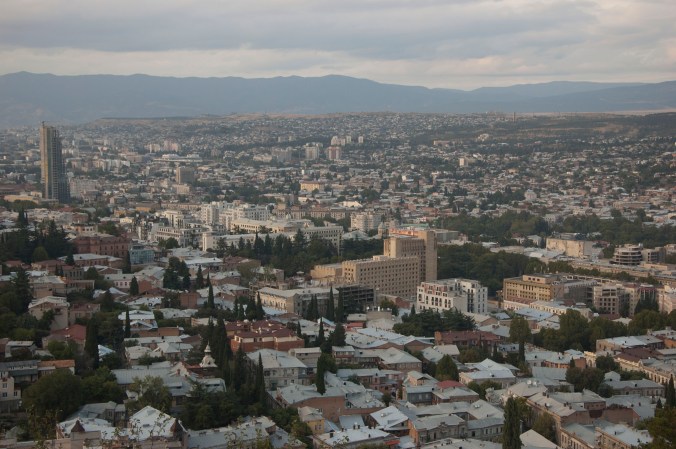
View via Tbilisi, Lotkini is in the center behind the trinity cathedral
The interdesign seminar had the aim to find methods to build the environment of a big city within an urban growth and a massive increase of population.4 To study such questions the participants looked at the Lotkini district in Tbilisi (ლოტკინი), were 17 000 new accommodations were planned. During the interdesign the (international) experts tried to find answers on functional, aesthetic, and socio-cultural problems. Questions like the functional organization of a district, the public services, greenery, design and visual communication, and applied arts. The designer especially looked for aspects on graphic design, secondary architecture, and usability. At the end of the seminar the participants submitted a general concept for the district development for housing, industrial complexes, transport infrastructure, and public spaces.5
View via Tbilisi
The “Interdesign 1980” was the first seminar with international and interdisciplinary cooperation, which tried to solve problems of building a human environment. Furthermore it was a kind of opening for the Soviet Design authorities – like the VNIITE with Yuri Soloviev – to Western experts.6 But this seminar also showed also how limited the possibilities of ideas and plans were. At least only few points from the interdesign seminar found their way into the Lotkini district.
1 Unbekannt (1980): „Stadt-Design“ als Interdesign-Seminar in Tbilissi vom 6. bis 18. Oktober 1980, in: form (90), p. 80.
2Belgium, Bulgaria, Czechoslovakia, Finland, France, Great Britain, GDR, Hungary, Italy, Norway, Poland, Switzerland, Venezuela and the Soviet Union.
Against the background that I had studied twice abroad with a lot of good experiences, it was obvious for me to visit another university outside of Germany during the PhD project. And it was also consistent to combine this with writing my chapter about the West German Industrial Designers in a globalised world. Because of Fallan’s high quality research, as well as Norwegians‘ high fluency in English, I decided to apply for a research fellowship in Oslo. And happily, the department at the UiO were willing to invite me and offered me working space for two month.
Getting financial support for my Norway stay was also possible. Thanks to the Friedrich-Ebert-Foundation, which supports my PhD project since 2014, it was not too complicated to get extra money for my visit. If this way would not be successful, there were also a possibility for Germans to apply at the Willy-Brandt-Foundation in Oslo, because they are also supporting academic exchanges for researchers. It would also be possible to apply for a short visit scholarship from the German Academic Exchange Service.
Beside the whole organisation of my visit in Oslo, there was one detail I was really astonished about in a positive manner. All correspondence, contracts, and inquiries were in a digital form. Furthermore my impression was that everything went on quite fast. For example “digital” and “fast” are not adjectives I would use for the German bureaucracy, especially at universities. That is a good thing to show, that in Germany e.g. a lot of time and energy is invested in discussions on a digital life – and in Norway many things are made more pragmatic in this point. Or to reflect one self and use the word from an interview with foreigners in Germany: “Paper in Germany is valued like God”.
The art history section, where Professor Kjetil Fallan and his colleagues are working, is part of the Department of Philosophy, Classics, History of Art and Ideas – or the short form in Norwegian “IFIKK”. The department itself is situated at the Campus Blindern, in the Georg Morgenstiernes hus. This 1960s red brick building was renovated a few years ago, so the interior space is quite new and very delightful. At the first day I was kindly welcomed by everybody and I got a working space with two other nice PhD students from art history in the room. Also I received an access card and a room key, to be able to work outside the main working hours or at the weekend. Get a room, card and keys as an external founded PhD student at the LMU in Munich, I have not heard that this has happened. Thus, these small details can demonstrate what kind of appreciation and attention in Norway is given towards scientists, PhD students and guests.
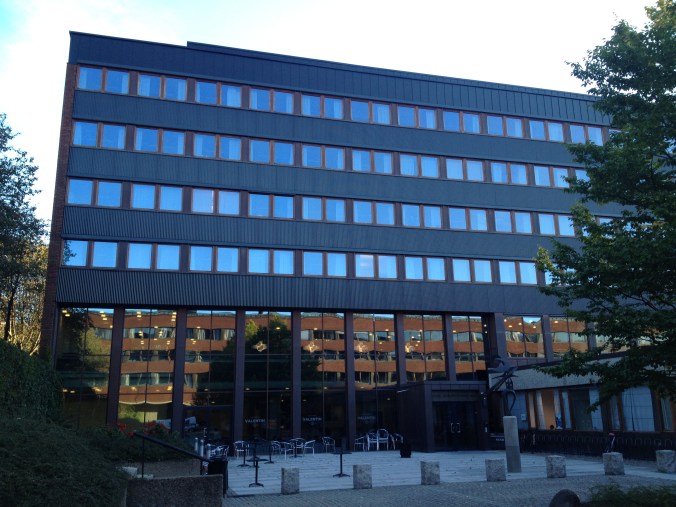
Georg Morgenstiernes hus
All the art historians in the department where very kind and open towards me, especially Kjetil and his PhD students Ingrid, Ida, and Gabriele integrated me so thoughtfully. Also new and remarkable for me was in which way the university is caring for the employees. Every Monday a huge basket with a variant of fruits were delivered. A fully-automatic coffee machine was also free for use. Also home office, part time or parental leave are not extraordinary, in Norway they are already ordinary. Getting a kindergarden place in Norway is not a lottery game, like it is in Munich. So everything gave the impression, that one looks with care after its employees. In comparison to a German higher education institution and the German sciences system, the difference catches the eyes.
In this great atmosphere, it was possible for me to write my chapter about West German industrial designers and their discourses about globalisation. Besides that, I was also able to write a short paper about the special German-German design relations in the Cold War. In comparison to German PhD seminars, the Norwegian procedure is more a text discussion. Thus, this means more writing an article and only giving a brief presentation, followed by a comprehensive discussion. I had the feeling, this procedure has some advantages. Because first, the author has a text, on which s/he can work and e.g. re-write parts to make it better. And second the audience can prepare itself and do not have to listen to over-length presentations. I was very pleased with the seminar and all the questions, comments, and tips I got on my text. Thus, perhaps I can keep working on the text, when I am back in Germany. With some luck, I will find a place to publish these results.
For living, there is a possibility to apply for researcher housing at the student welfare organisation for students in Oslo (SiO). In my case it was a furnished, small room in the Sogn student village, next to the Blindern Campus. It was ok to stay there for two months, but in the end, I cannot recommend it. Because the SiO has housing “quality”, “services” and invoices, which are not in a balanced proportion. Unfortunately the housing market in Oslo is as bad as in Munich. So you need quite a large portion of luck to find something that is fitting, affordable, and not behind the bushes. Beside the fact that the costs of living in Norway are as high as their reputation. In comparison to Munich – which is the most expensive city in Germany – I would guess that you have to spend about 30% more for food and the daily life. So with the German salary for PhD students – which is also low in Germany itself – you really have to live economically and fugally.
The regional office of the Friedrich-Ebert-Foundation is more focused on Sweden. Norway or Oslo are unfortunately not their main focus. But beside this, the Goethe-Institute in Oslo is organising a couple of interesting events in Norway’s capital city. Especially the podium discussions e.g. about the phenomena of populism, held in the Litteraturhuset, was really worth attending. I also can recommend the Opera House, the National Museum and the Vigeland Museum together with the Vigeland Park in Oslo. Trips to Bergen, Kristiansand, and Lillehammer are also good to make by train and a tip in every travel book. Also Stockholm is not so far away, a high-speed train brings you there in less than five hours.
Thus, thanks to Kjetil, Ida, Ingrid, Gabriele, Gustav, Anne Lise, Aron, Ellif, Espen, Heidi, Lars, Lena, Nikita, Panagiotis, Pia, and all other IFIKK-members for great two month in Oslo!
And I wish all of you a great Christmas time and a happy new year!
This summer I was able to make a research in the Design Archives at the University of Brighton. After attending the conference on the 50s anniversary of the Design Research Society (see my report), I stayed longer in Brighton to visit the Design Archives.
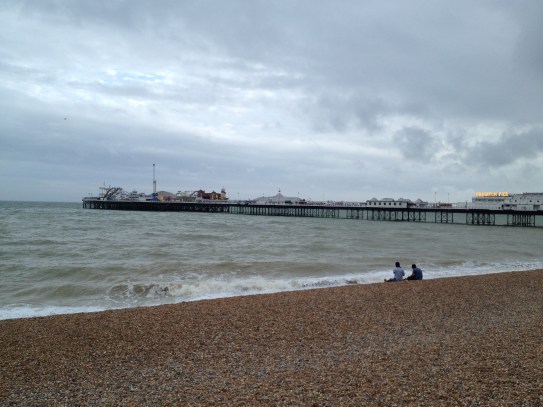
Brighton pier and the sea
This institution is one of the most important, paper based archives for design history. It was founded in the 1990s and contains of about twenty different archives, which cover aspects of graphic, furniture and industrial design. Financed by the government and private foundations, the archive is collecting different types of documents related to design. And it is not a coincidence that Brighton keeps such a great institution. One hour far away from London at the channel, the University of Brighton is one of the leading institution in Great Britain within the field of the design histories.
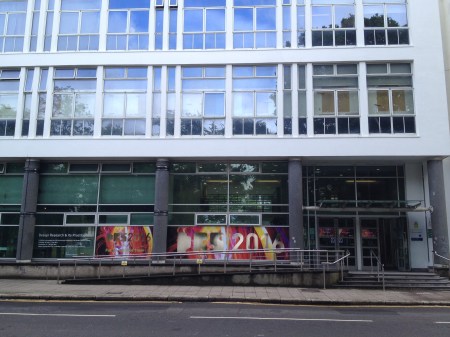
Entrance to the Design Archives at the University of Brighton
As in every other archive, you have to ask for an appointment and as well for a permission, to see contemporary material. Via email or by phone it is easy to contact the very helpful staff of the archives. As a finding aid the archival items are listed in the online hub of UK archives. They store the description from about two hundred institutions in Britain, that keep historical documents. By this service it is quite easy to search and especially prepare your visit at an archive. I am asking myself why isn’t that possible for Germany or whole Europe?
Furthermore in the Design Archives it is allowed for users to take photographical notes from documents. This is not a reproduction, because you have to use your own camera and must cover the document with a plastic foliage with a good visible remark from the Design Archives. But anyway you have a picture of the document, so you can work on it at an later moment back at home. In my point of view it is a very good way to help the user and give security again right abuse for the archive. Again, why isn’t that possible in Germany?
My interest were the files in the ICSID archives, which came in 2007 from the University of Compiègne, where it was held on behalf of ICSID. In these papers I could see how the West German institutions – like the VDID, Rat für Formgebung or the IDZ Berlin – interacted with other industrial designers. And as a special German perspective it came clear to me that the ICSID was also an important battlefield in the Cold War. The delegates from East and West Germany i.e. at the conference 1975 in Moscow hand many discussion about the problems, how was allowed to come with which wording of the own state. Nevertheless this changed, and again Moscow was – in my point of view – the turning point. Because here it was the first time that industrial designer from East and West Germany came together. Keeping on this, I am arguing in my thesis that in the 1980s there was no iron curtain for some parts of the industrial designer at the inner German border anymore.
The Cold War is fortunately over, but parts of its memory are stored in the Design Archives. In Brighton, they do not only „store“ documents, they also conserve them. In an inspiring blog the staff is writing about their doings, so everybody can follow what a great job they do. Beside this a lot of thesis are written with sources from the Design Archives by many PhD students. The most important one for my research field is the project from Tania Messell about the history of the ICSID. I am really looking forward to that publication.
Diese Diashow benötigt JavaScript.
The Design Archives at the University of Brighton also work on different exhibitions, i.e. about the history of the Design Research Society, that was presented parallel to the DRS2016. And it would be totally wrong calling the Design Archives old fashioned. They are open for digital tools on the internet – not like so many archives or museums in Germany. For example the Design Archives make a lot of documents online accessible, as well as many pictures in the VADS database. Furthermore the staff of the archive use a Flickr-account to give their masterpieces a stage on open access. It is also less surprising that the Design Archives use social media like twitter @design_archives to communicate.
Sign to the Design Archives
To sum up: Visit to the Design Archives at the University of Brighton, for design historians it is really worth to go there!
This year in summer the British Design Research Society celebrated its 50th anniversary with a big conference in Brighton. About 600 designer and researcher from Great Britain, Europe, and the world came together at the DRS2016 in the lovely seaside city, one hour south of London. The main theme of the conference was „Future-Focused Thinking“, which related to the popular designer self-understanding, designing the future and especially being the right profession for that task.
Brighton Pier and the sea
The conference was well organized and soon fully booked, although the registration fees with more about 400£ for three days were anything but cheap. Nevertheless I was really appreciated about the use of digital infrastructure at the whole event. The conference program was mainly organized via an online tool – what is not a real innovation nowadays. Anyhow this was combined with all the papers, the referents handed in before. In a pdf file and with a CC-BY license – I find that really refreshing – it was possible for me to prepare myself in advanced (all papers are online). In this way it was easier for me to listen the specific details more precisely than just trying to understand it, because your read the paper already before. Unfortunately the time at all sessions was planed very short, so there hadn’t been enough time for questions to the presenters. And further I still have a question about the digital persistence, because I am worried about the long-term storage of these research data.
What I also really appreciated was the decision not to give a keynote lecture. Instead there was on every day a podium discussion as a „starter“ with four experts from different fields about burning issues in design. The audience was able to ask questions via the Twitter hashtag #drsdebates. At the whole conference the hashtag #drs2016 was the digital code to share information to everybody. By using Twitter in this manner, all papers published online and an additional online exhibition about the history of the Design Research Society, it was also possible for people who weren’t in Brighton, to follow the conference from far away. Sharing the information in this way worked excellent and I would wish to see such an active use of digital tools also more on German conferences – may be at the Historikertag 2016 in Hamburg.
Diese Diashow benötigt JavaScript.
From the greatest interest for me was one session on design history, that lasted the whole first day in the Old Courthouse. These panels from the 29th June was called „History, Theory, Practice – Histories for Future-Focused Thinking“ were led by Maya Oppenheimer (Royal Collage of Art, London) and Harriet Atkinson (University of Brighton). This was organized in cooperation with the British Design History Society chaired by Jeremy Aynsley (University of Brighton). The main aim was to reflect what happened since the famous Design Method conference from 1962.
After the lunch break Tania Messell opened the next section with her paper about „International Norms and Local Design Research“ at the ICSID and its engagement in Latin America in the 1970s. Messell, a PhD candidate at the University of Brighton, supervise by the professor for design history Jeremy Aynsley. She gave convincing ideas about how design was used as a development topic between the so called first and third world. By looking at this, it became clear how western focused the ICSID was as structured. Messell’s PhD thesis will close a big „research gap“ in design history and help to understand the globalized network of the industrial designers since the late 1950s. I am really looking forward to her book.
After that Sylvia (Technical University Berlin) and Christian Wölfel (Technical University Dresden) presented some of the results (see Wölfels paper), which they published 2014 within their book about Martin Kelm and the „good“ GDR design. This publication was – part time for reasons – criticized by German design historians (i.e by the design historian Siegfried Gronert or the eyewitness Günter Höhne). But nevertheless it was commendable the save Kelms story of his work as a design manager in the totalitarian system of the GDR. And it was also a enriching step further by the Wölfels to bring up questions about the GDR on the“radar“ of the no-German speaking design historians.
The third presentation in the section gave Ingrid Halland Rashidi from the University of Oslo – so she’ll be one of my colleges when I am as a visiting PhD fellow in Norway’s capital in fall this year. In her paper she followed the path of her PhD thesis by presenting thoughts and a re-reading of the exhibition „New Domestic Landscape“ about Italian design at the MoMa 1971 (see Ingrids paper). Her main question was if a work would always operate within the framework of human intention. By asking this she questioned the agency beyond human intention in an museological context, and the audience was very pleased about this.
The section was completed by the paper from designer Isabel Prochner (Université de Montreal) on current question about feminist work in industrial design (see Prochners paper). Her point was that in the 1980s and 1990s there was much more feminist critique than it is today. So Prochner claimed for a rebuild of feminist work in industrial design. Her paper was widely discussed in the follow conversation between presenters and the audience.
After the tea break the session on design history was re-opened by Kees Dorst (University of technology Sydney and Eindhoven University of Technology) (see Dorsts paper). He asked in a quite refreshing manner, if design practice and research would finally find together. Dorst emphasized in his presentation, that the ambition to create a „science of design“ in the past can be criticized for being too disconnected from design practice. With that he claimed for a new way of thinking „academic design“. This last session on design history was finalized by the papers from Tao Huang (Southern Illinois University at Carbondale, USA) with an advertisement on contemporary Chinese design, Adam de Eyto’s (University of Limerick) short history of Irish design and Joyce Yee’s (Northumbria University) appraisal of the current situation of the so called design research.
Diese Diashow benötigt JavaScript.
So when I resume, even if „only“ one whole day was focused on design history, there weren’t that many papers on this special part of the history. This is not surprising, because the Design Research Society has its major focus on current design questions and not on the past – like the Design History Society. Looking at this I had the whole conference the impression, that the way of arguing, presenting a thesis and coming to new topics set apart from the historians on the one side and the designer on the other side. But even thou this was one of the great strength of the DRS2016 to bring these both groups together. Because the possibility to listen to papers that were not from the own research field, can be enriching and build new bridges.
Gary Anderson and his original design of the recycling logo, by Gary Anderson, CC BY-SA 3.0
The term „sustainability“ has become increasingly importance in many social debates. Current design history research looks at the aspect of „sustainability“ as well. In mid-June this year, a workshop entitled „Environmental Histories of Design“ was organized by the Norwegian Professor Kjetil Fallan (University of Oslo) along with Finn Arne Jørgensen (Umeå University) at the Rachel Carson Centre at the Ludwig Maximilian University in Munich. A Norwegian research group has been working on aspects of sustainability in design history since 2014. The team, led by Kjetil Fallan, runs its own research blog: www.backtothesustainablefuture.net.
The aim of the workshop in Munich was to discuss previously disregarded historical ties of design and sustainability. The contributions can be grouped into two different approaches. Arguments were either object or discourse-oriented, while both approaches have their advantages. More relevant is what questions are being asked. I methodically pursued a discourse analysis approach, thus it was very exciting for me to see how international colleges work with discourse analyses on design topics. I will briefly introduce three examples and bring in some thought of mine.
The debates in West Germany about design and obsolescence were explored by the Wuppertal Professor Heike Weber. The aspect of a planned life cycle of objects is currently discussed controversially. From a design historical perspective, we know relatively little about this topic. Weber argued, rightly so, that the life cycles of consumer items in the 20th century must not have necessarily reduced. This simplistic story must be questioned critically. The importance of the designer can certainly provide information about the historical development in the field of obsolescence.
The Norwegian Ida Kamilla Lie (University of Oslo) presented first results of her PhD project (based on her master’s thesis), in which she dealt with Victor Papanek’s importance for Scandinavian design discourses. Papanek was active, from 1966 to 1970, in the Scandinavian Design Students Organization (SDO). Particularly important was the question of the social responsibility of designers to society. Lie pointed out,that Papanek played a key role for the former generation of buddying designers. At the same time, this example is a profound analysis of how design discourses were already globalised in the 1960s and 1970s and then rapidly and widely adopted.
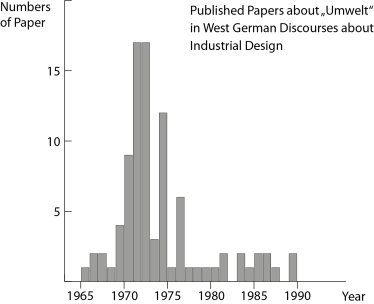
But what did the relationship of environmentalism and design mean in relation to the Federal Republic of Germany? I will try to discuss this shortly on the basis of published articles about environment and industrial design. The following graph shows the time distribution of published debate contributions, such as books, newspaper or magazine articles, which deal with „Umwelt“. This visualization of my literature database illustrates that the concept of environment was addressed from the 1960s to the 1990s onwards. Striking is the rapid increase from 1970 to 1972. A likely explanation could be the publication of Victor Papanek „Design for the Real World – Human Ecology and Social Change“ from 1971, as well as the publications of the Institut für Umweltplanung at Ulm (the successor of the Hochschule für Gestaltung Ulm). Papaneks book introduced the term “international environment” to the design discourse and experienced a varied reception.
Another interesting feature of this statistical distribution are the major differences between the years 1973-1974 and 1975-1976. The strong increase from 1973 to 1974 could be interpreted by the effects of the first oil crisis. This was a relevant development, which also affected the work of industrial designers. However, this shows that the environment was discussed by Papanek’s initiative in the Federal Republic until 1972. In the year 1973 significantly fewer players were published on aspects of the environment. This discussion is related again to the context of the oil price crisis of 1974.
The difference from 1975 to 1976 seems plausible if one considers that at the international ICSID Congress in Moscow 1975, the newly established Working Group „Environment and Design“ presented its results. The results of the ICSID working group were followed by a lot of West German Design, but not discussed further during the year 1976. Gabriele Oropallo (University of Oslo) deals with this aspect in his doctoral thesis. He presented parts of his research results at the above-mentioned workshop at the Rachel Carson Centre. Oropallos research will problematise and analyse the ICSID group, headed by GDR designer Martin Kelm. Remarkably, the contemporary understanding of the term environmental “Umwelt” is not congruent with the current meaning. Nevertheless this shift in meaning is also a big challenge for all researchers‘ in the history of design.



 yves vincent grossmann